
How SMARC and OSM enable product developers to eliminate single-vendor dependency — and build supply chains that hold up when it matters.

Supply chain disruptions are no longer an exception. They're a planning assumption. Component shortages, end-of-life announcements, geopolitical pressures, and single-vendor dependencies have forced engineering and procurement teams at mid-market manufacturers to rethink their hardware strategies — not someday, but now.
System-on-Module (SOM) platforms sit at the heart of most electronics-enabled products. When a key SOM is unavailable or goes on allocation, the downstream impact is real and fast: halted production, costly re-spins, delayed launches, and missed revenue. The goal of a vendor-agnostic SOM strategy is straightforward: ensure the supply chain holds by giving your company multiple qualified part numbers and supplier relationships before issues arise and impact your ability to ship.
This paper walks through the realistic options for getting there: what the open SOM standards make possible, what they require, and how to honestly assess whether the investment is right for your business. There's no single right answer — but there are clear frameworks for finding yours.
Cargt Perspective: Cargt has executed SOM vendor transitions on live production programs. The nuances in this paper come from that experience, not a whiteboard. If you want to talk through your specific situation, we offer a complimentary Design-to-Delivery Assessment at www.cargt.com.
If you're designing a new product, you have the most flexibility to architect vendor agnosticism in from day one. Two primary approaches exist, and understanding the difference matters.
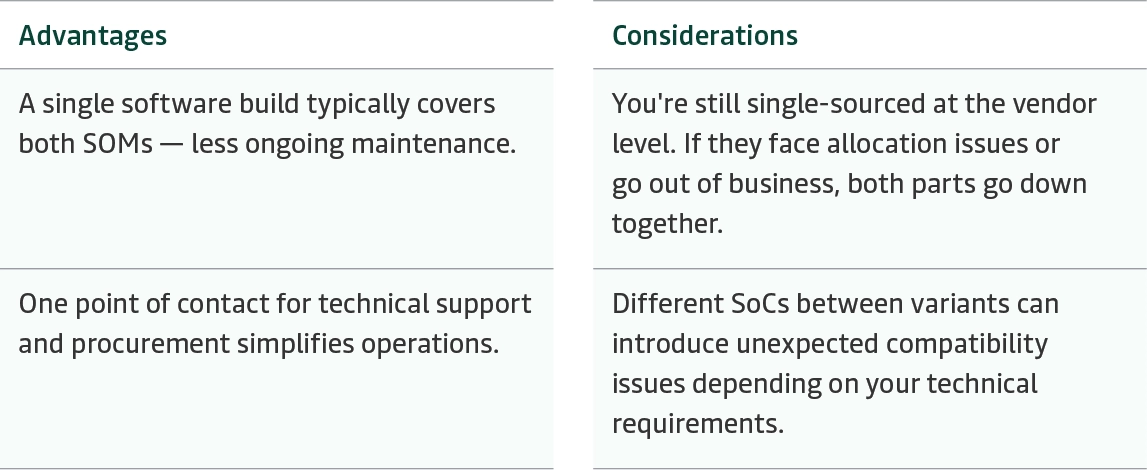
Option 1: Two Pin-Compatible SOMs from the Same Vendor
Many SOM vendors offer multiple modules that share a common pinout within their own product line. This lets you qualify two part numbers against a single carrier board design.
Option 2: Pin-Compatible SOMs from Different Vendors
This is true dual-sourcing — and until recently, it was genuinely difficult to execute. The emergence of SGET open standards has changed that. Cross-vendor pin compatibility is now achievable without a carrier board re-spin, provided you select the right standard at the design stage.
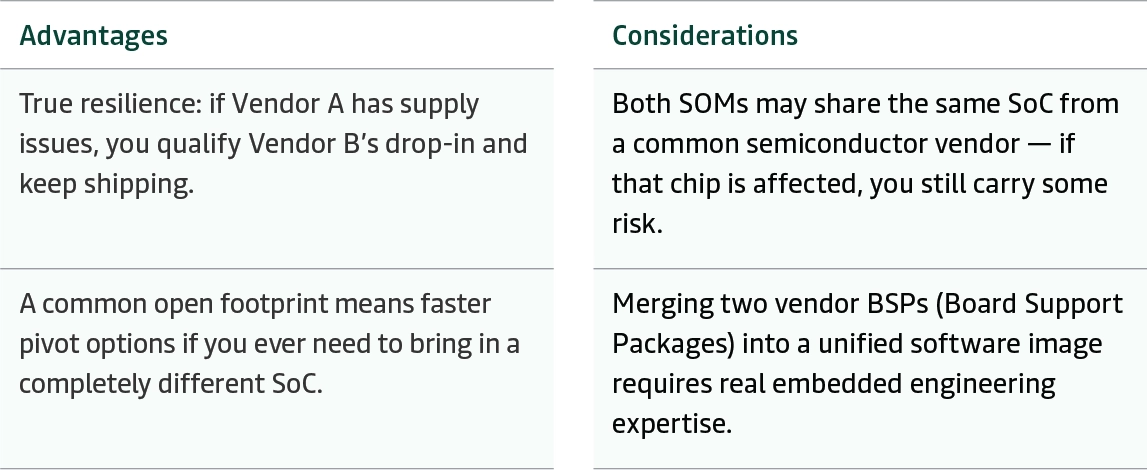
Key point: Option 2 is the gold standard for supply chain resilience. The open standards covered in the next section are what make it achievable — without starting your carrier board from scratch.
SGET (Standardization Group for Embedded Technologies) is the industry standards body — comparable in function to the Bluetooth SIG — that defines and publishes open SOM specifications. SGET membership gives companies the right to use materials and specifications commercially; Cargt holds an active SGET membership. Three primary open standards are relevant to most embedded product teams today.
Qseven: The Foundation
Qseven was the first widely-adopted open SOM standard released in 2008, using a 230-pin MXM2 card-edge connector. It served the industry well for years, but 230 pins proved insufficient as interface requirements grew. Qseven has been largely superseded by SMARC and is not recommended for new designs. Its main legacy value is installed base — if you’re running an existing Qseven design, there are still vendor options, but the window is narrowing.
SMARC: The Workhorse
SMARC (Smart Mobility ARChitecture) is the current production standard for most open SOM deployments. Released in 2013, it uses a 314-pin MXM3 card-edge connector and is supported across a broad range of SoC vendors. SMARC modules are physically socketed into the carrier board — meaning they can be removed, swapped, and tested on a bench without any soldering.
For teams that need field serviceability, rapid prototyping flexibility, or straightforward bench testing workflows, SMARC remains the right choice. It’s proven, widely sourced, and well-documented.
OSM: The Next Generation
In 2020 SGET released OSM (Open Standard Module), the newest generation of open SOM standards, and it’s where the industry is heading. The fundamental difference from SMARC: OSM modules are soldered directly to the carrier board via an LGA (Land Grid Array) pad array at 1.25mm pitch — there’s no connector allowing for a larger number of connections.
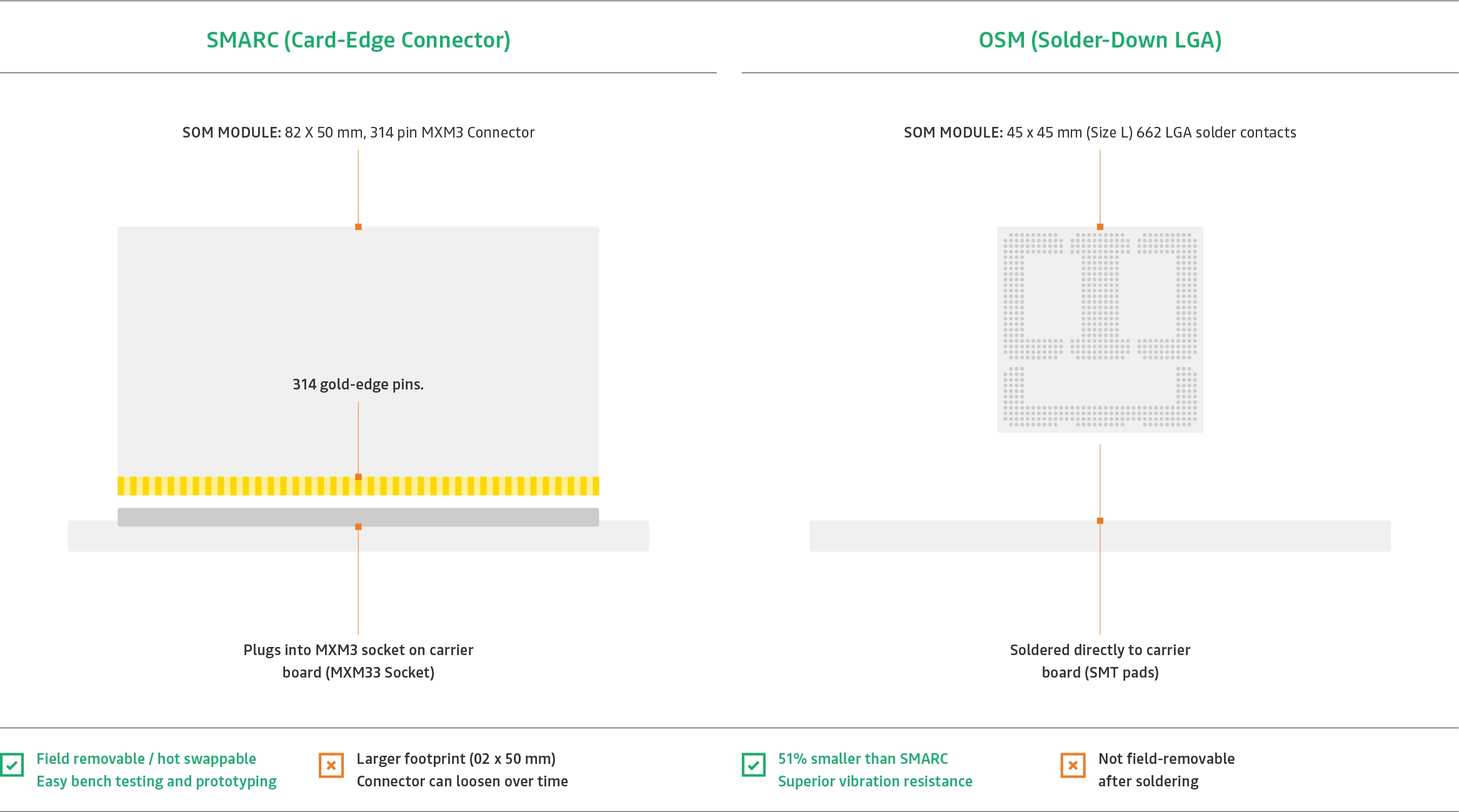
Trade-off: Solder-down is not for every team. Without the connector, an OSM module can’t be pulled out for bench diagnostics or field swaps. Organizations need to invest in proper test infrastructure before this approach pays off. Once that’s in place, the benefits — smaller footprint, better signal integrity, higher pin density — are real and significant.
OSM is defined in four sizes, and this is where the design elegance shows. Each size is a true superset of the one below it — the pinout of Size-0 is physically contained within Size-S, Size-S within Size-M, and so on. This means a smaller module can fit on a larger carrier board footprint without redesign, and migrating to more capability doesn't require a carrier board re-spin.
Osm Form Factor Sizes - Superset Architecture
Each larger size comntains the complete printout of the smaller sizes at identical positions
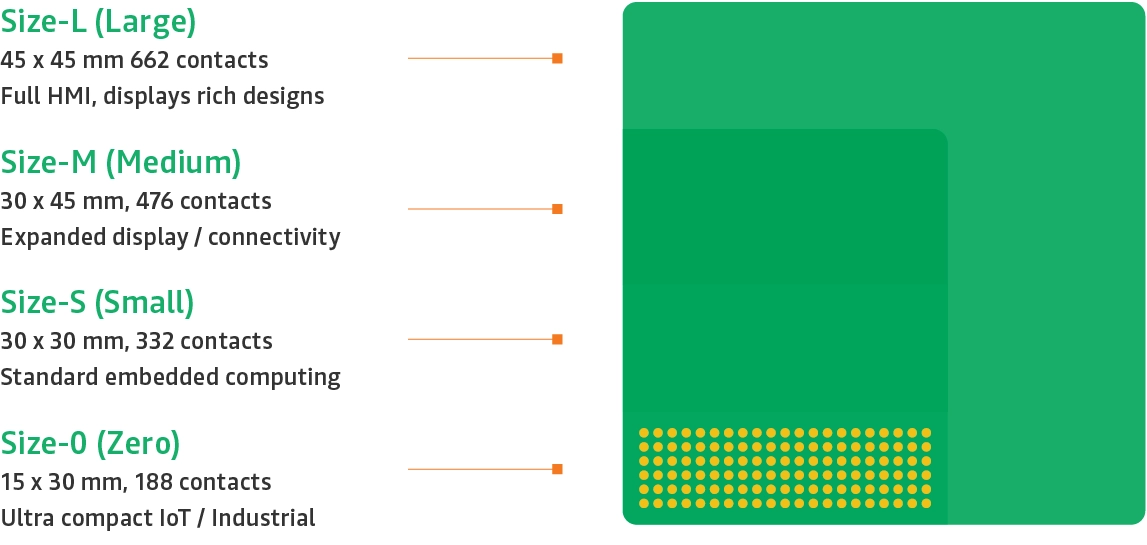
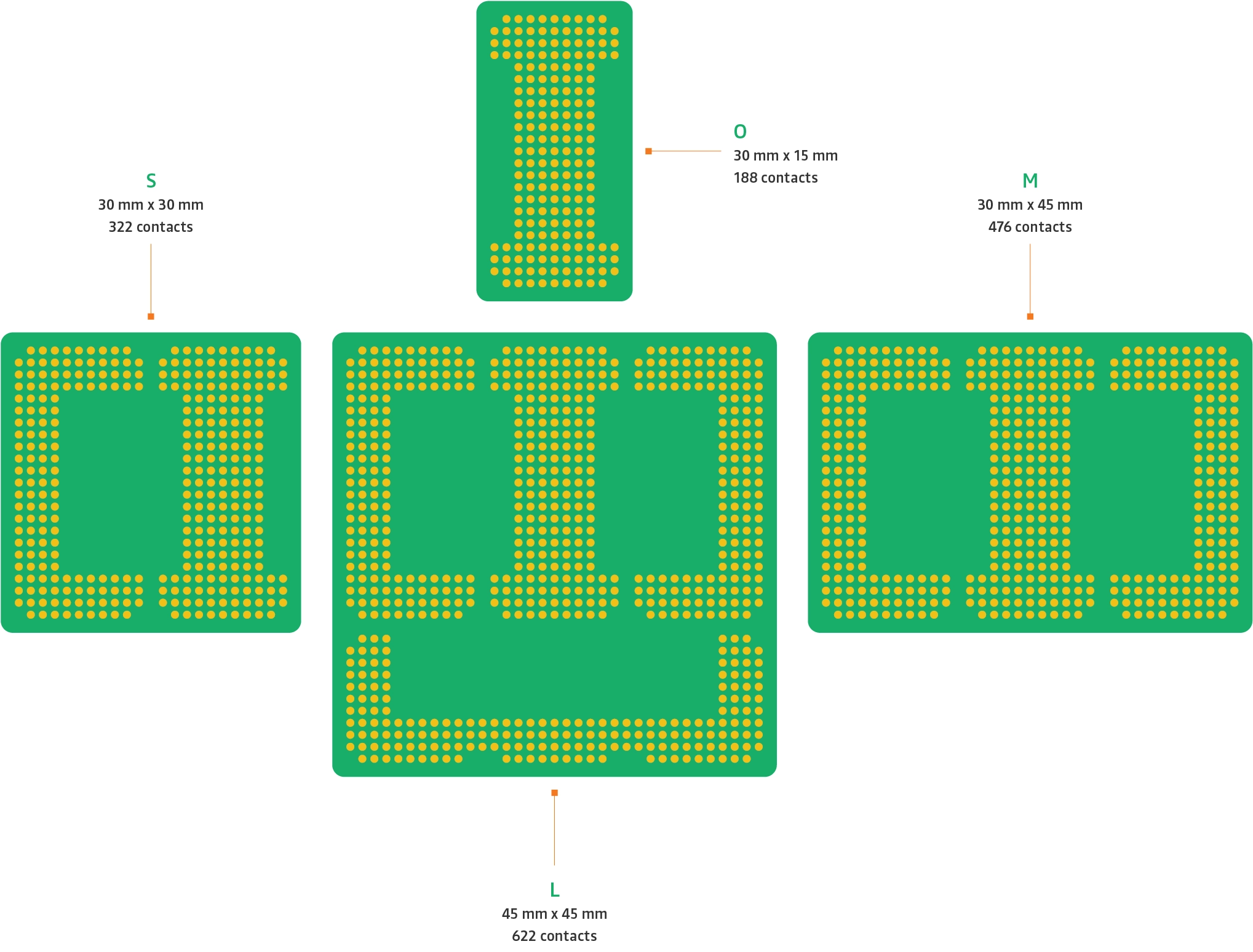
Hmi and display note: Cargt’s primary focus is Size-L (45×45mm, 662 contacts) for HMI and display-rich applications which provides better support for multiple display output types. Smaller sizes can be a strong fit for ultra-compact IoT nodes where display I/O isn’t needed.
Open standards provide the foundation. They do not eliminate the engineering work. Teams that go into dual-vendor SOM programs expecting a plug-and-play experience tend to be the ones that struggle. Here’s where the real complexity lives.
Pinout Compatibility Nuances
Open standards define a common footprint and core signal assignments — but they also reserve “vendor pins” that each SOM maker implements differently. Two SMARC or OSM modules from different vendors will be largely compatible, but not identical at every pin. Carrier board design needs to account for these differences upfront, and qualifying two vendors requires rigorous electrical validation across both variants. This is manageable, but it’s not free.
Software, BSPs, and the Merge Problem
This is the hard part — and where most teams underestimate the effort. Every SOM vendor ships their own Board Support Package: the bootloader configuration, kernel patches, and drivers that bring their specific hardware to life. Running a single unified software image across two vendor SOMs means you need to:
• Detect at runtime which SOM is installed on the carrier board.
• Branch the boot process to load the correct BSP, device tree, or driver stack for that specific SOM.
• Maintain, test, and validate both code paths across every future software update.
This is not boilerplate work. It requires engineers with hands-on bootloader and device tree experience — people who understand what’s happening at the hardware/software boundary. If you don’t have that on your team, the cost to acquire it has to be part of the investment calculation.
Honest assessment: Cargt has done this work. We know where the edge cases are, and we know which SOM pairs play well together versus which ones create ongoing integration headaches. If you’re evaluating a dual-source strategy, that institutional knowledge is worth a conversation before you commit to a direction.
If you’re already in production with a design locked to a specific SOM vendor and the supply situation is making you nervous, your options are more constrained — but not none.
Engage a Design House or Experienced SOM Partner
While some design houses and SOM-specialist partners have the capability to create a drop-in replacement for an existing carrier board, many don’t have the willingness. (Most are unwilling to engage – requires more hands-on support for the customer. Cargt gives more direct support that is focused per customer …. ).
Building something that’s electrically, mechanically, and sofware compatible with your current SOM footprint (even if it was never originally designed to an open standard) is worth pursuing, but go in with clear eyes: most vendors won’t do this work, and for good reason — it’s technically demanding and carries real risk if executed poorly. When you’re evaluating partners, ask directly: Have you done a SOM swap on a non-standard existing design? How many times? What were the failure modes?
Cargt Differentiator: This is work that Cargt is willing to take on. We bring the hardware validation, software merge, and dual-path testing under one roof — and we’ve done it on live production programs, not just prototypes. From Concept to Production, Without the Risk.
Vendor agnosticism via open SOM standards is a legitimate supply chain resilience strategy — but it’s a business decision as much as an engineering one, and the honest answer isn’t always “yes, do it now.” Before committing, three questions deserve real answers.
Do I have the right team?
The software merge is the hardest part of this program. If your embedded software team doesn’t have deep BSP and device tree experience, the cost of building that capability may outweigh the supply chain benefit. That’s not a knock — it’s a resource allocation reality. Know what you’re walking into.
Is dual-sourcing worth it compared to alternatives?
Open standards aren’t the only way to reduce SOM supply risk. Consider the full set of tools available:
• Strategic inventory — hold enough buffer stock to cover your transition time if a SOM goes on allocation. For many businesses, three to six months of key components is a pragmatic, cost-effective hedge.
• Long-term supply agreements with your primary vendor.
• Last-time-buy provisions triggered by an end-of-life notice.
The math depends on your volume, your cash position, your production velocity, and your re-spin timeline. A team that can execute a board change in three months needs far less buffer inventory than one facing a twelve-month certification cycle. Run the numbers for your specific situation before making a strategic decision.
Should it be a priority right now?
Engineering bandwidth is finite. Investing in a dual-SOM program means those engineers aren’t pursuing new product development, new markets, or other risk mitigation work. For organizations with strong embedded software teams and high production volumes where a single-vendor failure would be catastrophic, the investment clearly pays off. For others, a disciplined inventory strategy may be the smarter near-term move — while you design open standards into your next product from day one. That’s actually the best long-term answer for most teams: start clean. Design your next product to SMARC or OSM even if you launch with a single vendor. You don’t have to execute the dual-source program on day one — but you’ve preserved the option without a re-spin. That optionality has real value, and it costs nothing to build in at the design stage.
The bottom line: Open standards have made true vendor agnosticism achievable. Whether to pursue it now — or design the option in and execute later — depends on your team, your risk exposure, and your alternatives. Cargt can help you think through the decision, and execute the program when you’re ready. Book a Design-to-Delivery Assessment at www.cargt.com.
About Cargt
Cargt is a vertically integrated electronics design and manufacturing company based in Lenexa, Kansas. We bring design, engineering, and production under one roof — enabling mid-market manufacturers to modernize electronics-enabled products without disruption, unnecessary delay, or vendor lock-in.
Whether you're looking for more information, need a custom quote, or want to discuss your next project, we're here to help. Complete the form below and a member of our team will be in touch soon.